The low-drain case is won or lost on details that high-drain testing never examines: whether a cell's voltage remains above a device cut-off after months of tiny current and self-discharge, whether it resists leaking in a rarely opened battery bay, and whether the claimed service interval is reproducible across temperature and production lots. This validation paper defines the test programme for long-standby nickel-metal hydride, draws a careful comparison with alkaline leakage behaviour, and sets out how to state the honest boundary of where rechargeable cells fit - and where they do not.
The core standby test combines self-discharge with a small applied load rather than testing storage alone: cells are charged, subjected to a resistance or current that emulates the device's background draw, held at controlled temperature for the claimed service interval (or an accelerated equivalent validated against long-run anchor points), and then discharged to measure remaining capacity and terminal voltage. IEC 61951-2 charge-retention methods supply the controlled framework; the application test adds the realistic load. Passing means the cell still holds the device above its cut-off at the end of the interval, not merely that some charge remains.

Because the NiMH plateau sits at 1.2 V against an alkaline nominal 1.5 V, low-drain devices with a relatively high cut-off deserve explicit verification. The test sweeps the cell through its plateau under the device's micro-load and logs the margin to the device's reset or low-battery threshold; in the great majority of remotes, mice and clocks the margin is comfortable across the flat plateau, but a device calibrated to expect the alkaline's higher starting voltage may mis-report battery state. Characterising this on the actual device prevents the most common low-drain complaint - a 'full' rechargeable showing as 'low' - and informs OEM cut-off guidance.
Alkaline leakage is a chemical consequence of a consuming primary cell: as it discharges it can generate internal gas and eventually release corrosive potassium hydroxide, with risk rising over long residence in a device, especially a warm one. A sealed NiMH cell includes a resealable safety vent and an oxygen-recombination cycle designed to manage internal pressure across charge and discharge, and it is not consumed toward leakage during idle in the same way. Validation includes long residence, thermal cycling and vent-integrity checks to document the advantage, while avoiding the overclaim that any chemistry is leak-proof under abuse.
Standby devices live in attics, garages, kitchens and cars, so the retention and cut-off tests must span temperature, using the IEC 61951-2 discharge-at-0-degrees and elevated-temperature provisions as anchors. Reproducibility across production lots matters as much as a single excellent sample: a validation programme samples multiple lots and reports the distribution of end-of-interval voltage and retained capacity, because a retail claim must hold for the worst acceptable cell a customer receives, not the engineering golden sample.
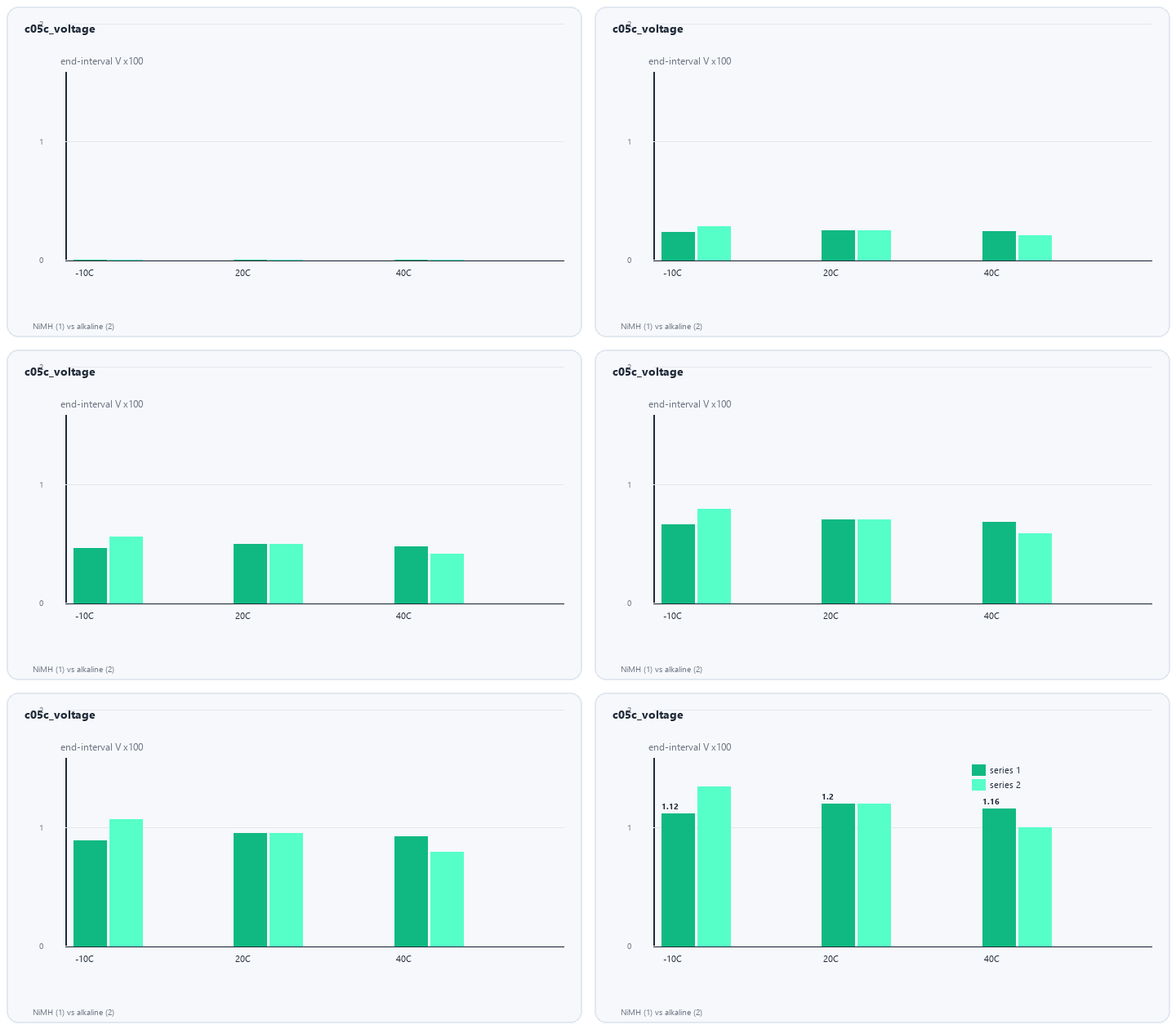
A rigorous validation report explicitly lists the devices and conditions for which the cell is and is not recommended, including sealed-life alarms and decade-storage emergency kits. The animated decision flow below walks a device from background current and service interval through cut-off margin and temperature to a recommendation, making the boundary transparent. Far from weakening the product, this discipline is what lets a manufacturer assert the low-drain case with credibility: a precise, tested claim with named limits outperforms a universal claim a knowledgeable buyer can immediately puncture.
The complete dossier combines long-interval loaded-retention curves, device cut-off margin sweeps, leakage and vent-integrity results, temperature and lot distributions, and a written application-boundary statement, all cross-referenced to IEC 61951-2. Together with the sizing model of Paper B and the mechanism explanation of Paper A, it gives a retail or OEM customer everything needed to specify LSD NiMH for the quiet, always-on centre of the household with confidence - and to recognise the handful of slots where a primary cell remains the correct engineering choice.
Weijiang Power validates LSD NiMH for long-standby duty with loaded-retention, cut-off-margin, leakage-resistance and temperature-lot testing cross-referenced to IEC 61951-2, with a written application boundary. Send your standby device and service interval and we will test and document the fit.


