Meaningful discussion of charge speed, efficiency and life requires shared measurement rules, and for sealed nickel-metal hydride cells those rules are set by IEC 61951-2, the standard for portable sealed rechargeable cells and batteries. It defines how a cell is charged and discharged for capacity rating, how endurance is cycled, how charge retention (self-discharge) is measured after storage, and how internal resistance is determined - all under tightly specified current, temperature and timing conditions. This final group opens by dissecting the IEC 61951-2 charge-related test methods, explaining why each condition is fixed as it is, how the standard's results relate to the in-application charging behaviour of the preceding papers, and how a laboratory reproduces them without the subtle errors that make battery test results non-comparable.
IEC 61951-2 standardises test methods for sealed NiMH cells and batteries used in portable applications so that ratings from different makers are comparable; its technique is to fix every variable that could change the result - charge current and duration, discharge current and end voltage, ambient temperature, rest periods and the number of conditioning cycles - leaving the cell under test as the only variable. A 'standard charge' is therefore a defined protocol, not a recommendation for how products should charge in use.
Distinguishing standard test charge from application charge is essential: the standard deliberately uses conservative, reproducible currents (typically a slow, timed charge) to rate intrinsic cell properties, whereas the fast, multi-criterion profiles analysed in this series are application methods evaluated against - but not identical to - the standard protocol.
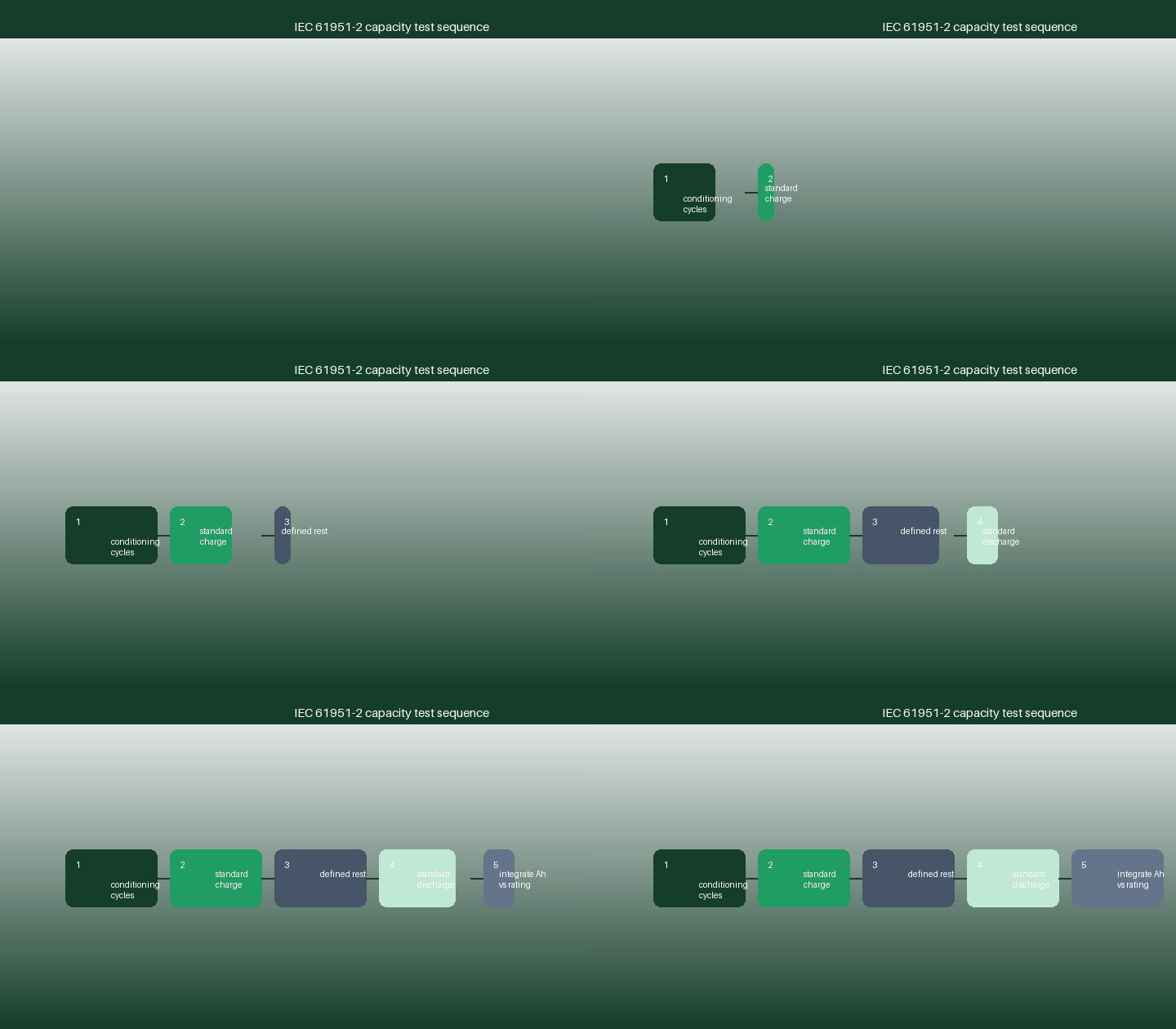
Rated capacity is established after specified preparation/conditioning cycles by charging under the standard charge regime at the controlled temperature, resting for a defined period, then discharging at a standard current to a specified end voltage and integrating delivered charge; a cell meets its rating if delivered capacity reaches the declared value within tolerance across the required cycles. Because discharge capacity depends on charge completeness, the standardised slow, full charge ensures every cell begins the discharge from a comparable, fully charged state.
In application terms, this is the reference against which charge-acceptance losses (Paper 2) and termination-induced underfill are judged: a fast charge that delivers 96 percent of IEC-rated capacity is quantifiably leaving 4 percent on the table, a comparison only possible because the standard defines the 100 percent baseline.
Endurance tests repeatedly charge and discharge under defined regimes, checking capacity at checkpoints and defining an end-of-life capacity threshold (commonly 80 percent of rated); the standard's cycling conditions provide a reproducible accelerated-ish baseline, while manufacturers and customers add application-specific charge protocols (the rate/depth/temperature matrix of Paper 24) to predict real service life. The distinction matters: IEC endurance demonstrates durability under a common protocol but does not by itself predict life under 1C fast charge in a hot enclosure, which needs a protocol-matched test.
Reporting cycle life always requires stating the charge regime - cycles-to-80 under standard charge is not transferable to fast charge - a point the standard's fixed-condition philosophy makes explicit.
Charge retention measures self-discharge: a standard-charged cell rests at a defined temperature for a fixed storage period, then discharges to measure retained capacity against its pre-storage value; this is the number behind the self-discharge modelling (Paper 16) and maintenance-scheduling decisions (Paper 34), and it explains why low-self-discharge grades are tested the same way but show markedly higher retention. Internal resistance is measured by either an AC (1 kHz) method or a DC current-step method under defined state of charge, giving the resistance values used for pulse and thermal design (Paper 17).
The AC and DC resistance values answer different questions - AC at 1 kHz approaches the ohmic component, while a DC pulse includes polarisation - so they must not be mixed when specifying charge-current limits, a common source of design error.
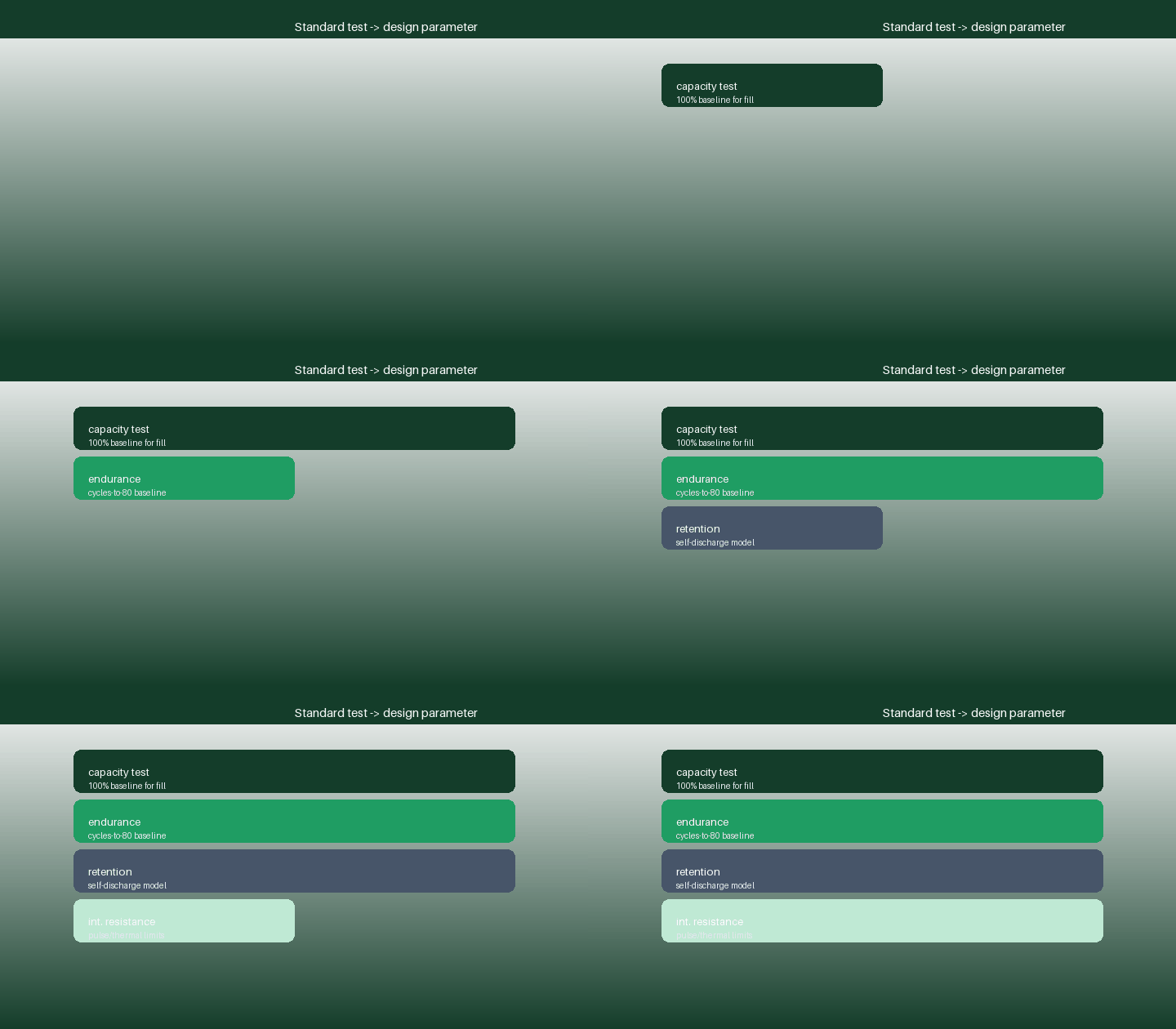
Reliable results require calibrated electronic channels with four-wire sensing, a temperature-controlled environment at the standard's specified ambient, accurate timing of charge and rest, and attention to the conditioning cycles that stabilise a new cell (the formation behaviour of Paper 25). Common errors include charging at non-standard ambient, skipping conditioning, using holder resistance in the measurement, and comparing capacity from different discharge currents. The first figure sequences a standard capacity test; the second maps each IEC method to the charge-design parameter it informs.
Treating the standard as a measurement contract - same protocol, same conditions, same endpoints - is what allows datasheet values, supplier comparisons and application validation to be reconciled.
Weijiang tests cells to IEC 61951-2 methods and provides capacity, endurance, retention and resistance data on that common basis, alongside application-specific charge-envelope characterisation; customers can therefore compare grades fairly and connect standard ratings to their own fast-charge validation. The next paper goes inside the laboratory to show how charge efficiency and the exact moment of 'full' are measured experimentally beyond the standard's baseline.
Weijiang Power designs and manufactures nickel-metal hydride cells, matched packs and charging-ready configurations for consumer, industrial, medical and mobility customers, and supports partners with charge-protocol guidance, IEC 61951-2 performance files, IEC 62133-1 safety evidence and charger co-validation. Share your cell format, charge rate, thermal envelope and cycle target and our engineers will specify a cell-and-charge combination that protects both runtime and service life. Review the range on the products page.


