An ultrasonic heat meter has no moving parts and almost no mechanical wear, so its service life is set almost entirely by its battery and its electronics. Governed by EN 1434 and, for legal metrology in Europe, the Measuring Instruments Directive Annex MI-004, it must measure flow by timing ultrasound in both directions, read a pair of precision temperature sensors, integrate thermal energy, and expose the result by radio or an EN 62056-21 optical port for six to eleven years on a sealed cell. Understanding that measurement-and-report duty cycle is the first step to choosing the power source - and to seeing where a small nickel-metal hydride pulse reservoir helps.
EN 1434 defines heat meters - the flow sensor, the paired temperature sensors (commonly PT500 or PT1000 platinum elements on flow and return) and the calculator that integrates flow with the temperature difference into thermal energy - and MID Annex MI-004 sets the essential legal-metrology requirements, typically accuracy class 2 with a wide dynamic range (a flow measuring range around 1:100 for the sensor and up to 1:1000 for the complete instrument in leading designs).
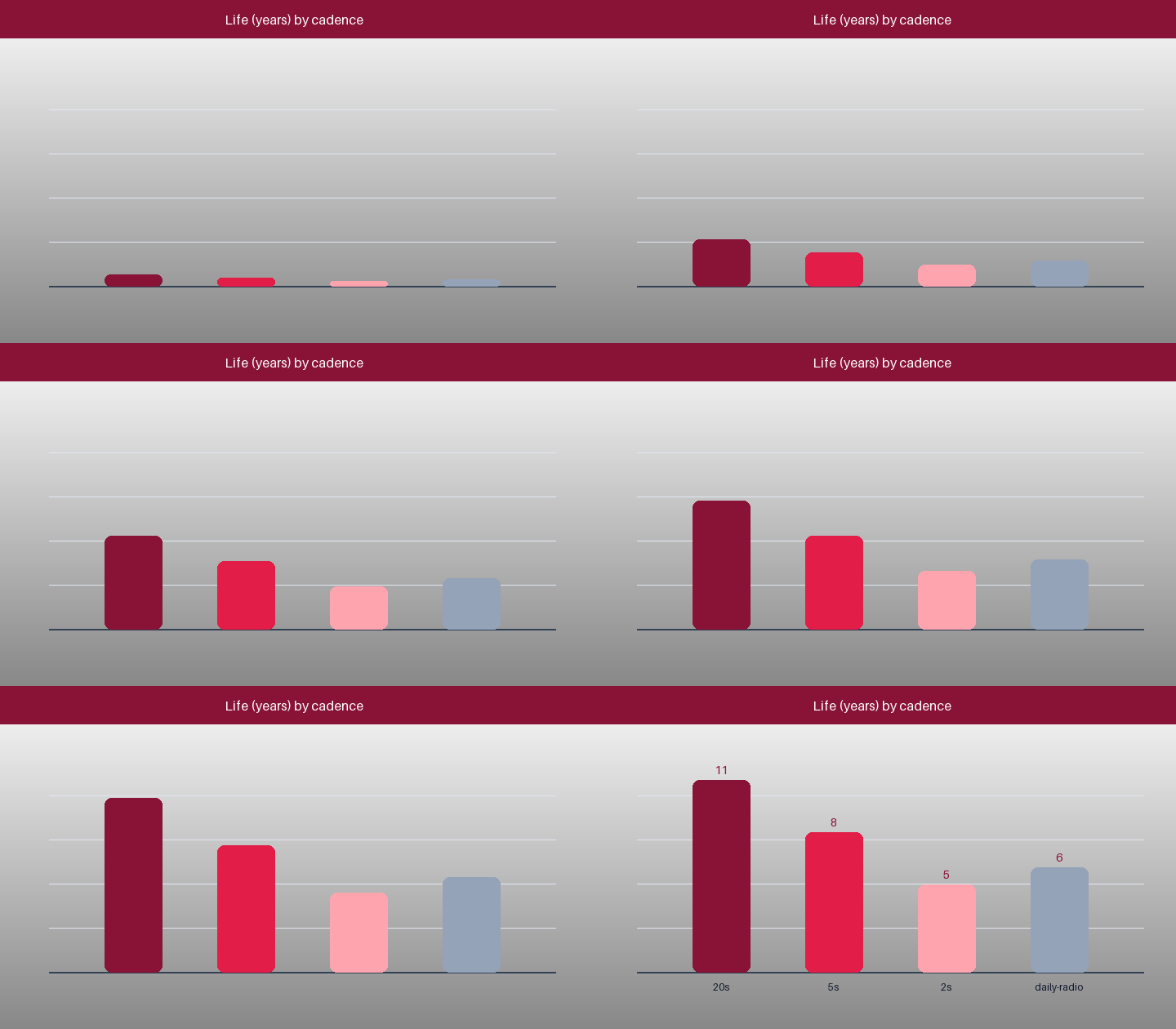
Mainstream products illustrate the power target: a Siemens UH50 or a Landis+Gyr ULTRAHEAT T230 is specified for many years of battery operation, with one T230 configuration quoting around eleven years at a 20-second measurement cadence, while a Qalcosonic HEAT2 targets environmental class C with a 5-55 C operating span. The common thread is an extremely low average power - on the order of half a milliwatt for a representative DN100 meter measuring every few seconds.
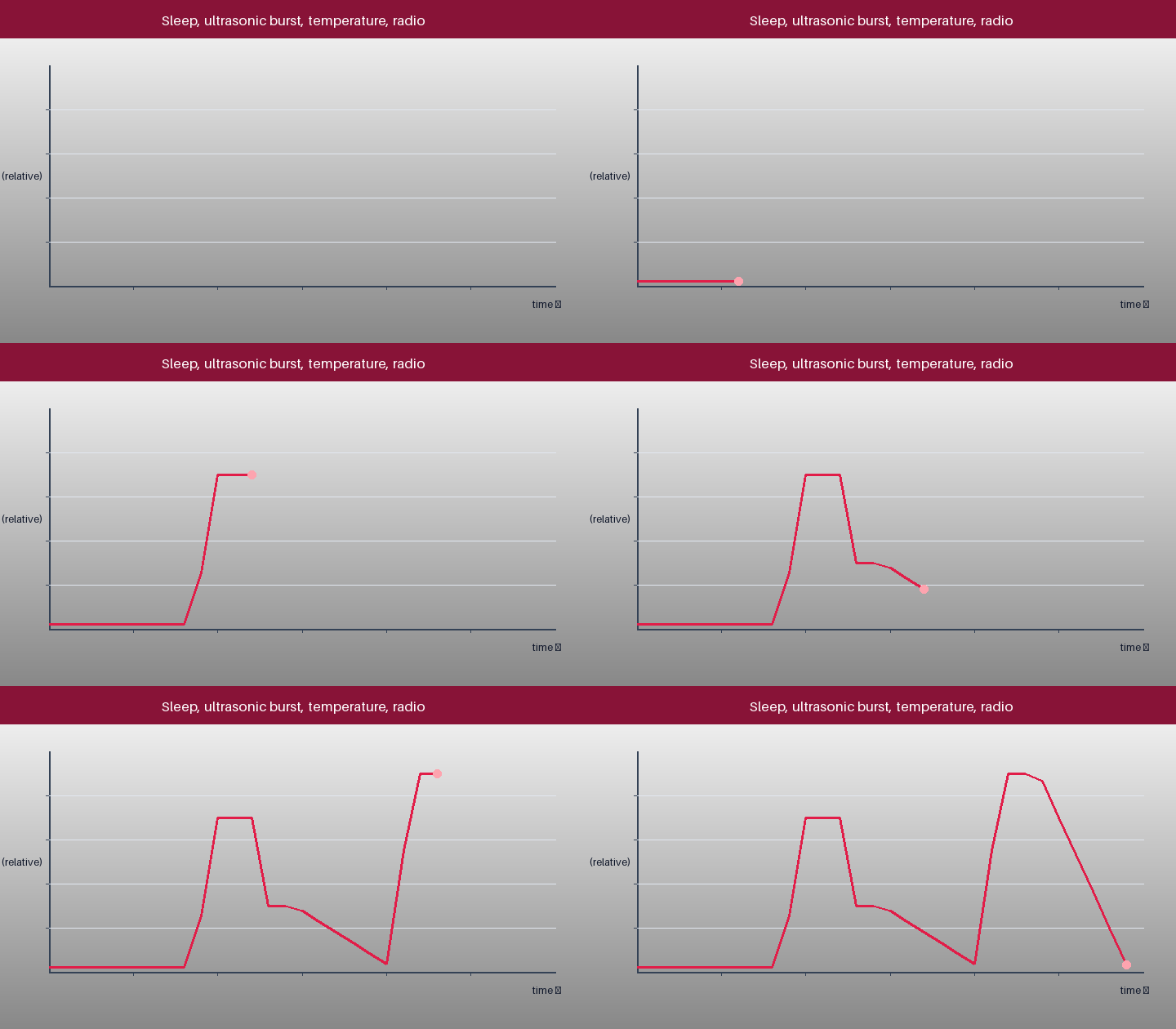
The first animated figure expands the meter's electrical life. Most of the time the MCU, ultrasonic front-end and radio sleep at microamperes. At each measurement interval the calculator wakes, fires the ultrasonic transducers in both directions (a brief, relatively high-current analogue burst), excites and digitises both platinum temperature sensors, computes flow and energy, and returns to sleep. On the reporting schedule - daily wireless upload, or a walk-by/drive-by optical or radio read - a longer communication pulse appears.
Crucially, designers exploit empty-pipe detection: when no flow is present, the meter stretches its measurement interval, and published designs show average power falling to roughly 30% of the flowing value. That adaptive cadence is the single biggest lever on battery life.
The second figure shows the same non-linear trade seen across smart metering: with fixed stored energy, shortening the measurement interval from 20 seconds to 2 seconds, or moving the radio from monthly to daily, compresses an eleven-year life toward six. Each ultrasonic burst is small individually but occurs thousands of times a day, so its energy dominates the long-term average even though the radio pulse dominates the instantaneous current.
Separating the two is the key design discipline: the long-term average-current budget sizes the energy cell, while the short ultrasonic and radio peaks size a pulse reservoir that keeps the supply voltage stable during measurement and transmission.
As with water and gas meters, the default energy store is a 3.6 V primary lithium cell chosen for energy density and shelf life. Its rising internal resistance with age and temperature, and its tendency to passivate, sit awkwardly beside the ultrasonic analogue front-end, which needs a clean, stable supply to time acoustic pulses to nanosecond precision, and the radio power amplifier. A sagging rail during the time-of-flight measurement is not merely a brown-out risk - it can degrade the very measurement the meter exists to make.
A small NiMH pulse reservoir - trickle-charged from the primary cell between events - supplies the measurement and radio bursts at low impedance with a flat plateau, isolating the precision analogue stage from the primary cell's impedance and protecting timing accuracy as the primary cell ages.
Heat meters live in heating substations and indoor meter cupboards that are warmer than a buried water meter - often close to warm pipes. That helps the ultrasonic measurement but accelerates self-discharge and, for any rechargeable element, demands disciplined charging: NiMH should not be continuously charged above about 45 C. In practice the reservoir is topped up in short, controlled pulses rather than left on a permanent trickle, and the pack is positioned away from the hottest pipework - manageable design rules that preserve the reservoir across the meter's life.
Where the meter is serviceable or powered by an external/bus supply during the heating season, NiMH becomes still more attractive as a rechargeable, replaceable store rather than a sealed-for-life element.
The brief records the measurement interval and its empty-pipe behaviour, the ultrasonic burst current, the temperature-sensor excitation, the radio or optical readout profile, the cabinet temperature class and the target life. Paper B turns these into a hybrid energy and pulse calculation; Paper C maps the design onto EN 1434, MID and the cell-level evidence.
Weijiang Power supplies sealed nickel-metal hydride cells and pulse-assist modules for ultrasonic heat meters and thermal energy sub-metering. Tell us your measurement interval, radio profile, temperature class and design life, and our engineers will design a welded NiMH pulse reservoir or service module matched to the primary lithium cell and warm heating-cabinet environment. Review formats on the products page.


